AI can write a 1,500-word blog post before you finish your coffee.
It can suggest headlines. Find keywords. Rewrite paragraphs. Create outlines. So here’s the question many businesses are starting to ask:
If AI can create content this quickly, why does SEO still take months?
Because writing the blog was never the hardest part of SEO. It was just one part of it.
A blog isn't automatically an SEO asset
Let’s say you ask AI to write an article targeting: “Best CRM software for small businesses.” You get a polished article in minutes. You publish it. And then…
Nothing happens. No meaningful traffic. No rankings. No enquiries. So you ask AI to write another one. Then another. Now you have 20 AI-assisted articles. But your competitors are still ahead. What happened?
The problem isn’t necessarily the writing. The problem is everything that happens before and after the writing.
1- AI can write about a topic. It doesn't automatically know your customer.
A tool can create an article about your product. But does it know why your customers choose you? Does it understand the questions your sales team hears every day? Does it know what makes your customers hesitate before buying? Does it understand the difference between someone researching a problem and someone ready to spend money?
That’s where human input still matters.
The best content usually starts with understanding the customer, not generating paragraphs.
Driving traffic is only half the equation. Learn how strategic digital marketing works best when paired with conversion-focused user experiences. .
2- Choosing the right topic is harder than writing it
This is where many businesses get stuck. They ask: “What should we write about this month?” Instead, they should be asking: “What are our potential customers actually trying to find?”
A topic can have thousands of searches and still bring very little business. Another topic might have far fewer searches but attract people who are much closer to making a decision. AI can help you generate ideas. But strategy decides which ideas are worth pursuing.
3- Search engines don't only look at how well your article is written
A beautifully written article doesn’t guarantee visibility. Your website still needs to be technically accessible. Your pages need to be connected logically. Your content needs to match what people are actually searching for. Your website needs credibility. And your overall content needs to make sense together.
Think of it this way:
A great blog is one good employee. SEO is the entire company. One good employee can’t fix a badly run company.
4- Publishing is only the beginning
This is another mistake businesses make. They spend hours creating an article. Then hit Publish. And move on to the next one. But what happens after publishing?
- Does the page get indexed?
- Is it gaining impressions?
- Are people clicking?
- Is it ranking for the intended searches?
- Are visitors engaging with it?
- Could the article be improved six months later?
Good SEO involves watching what happens after you publish.
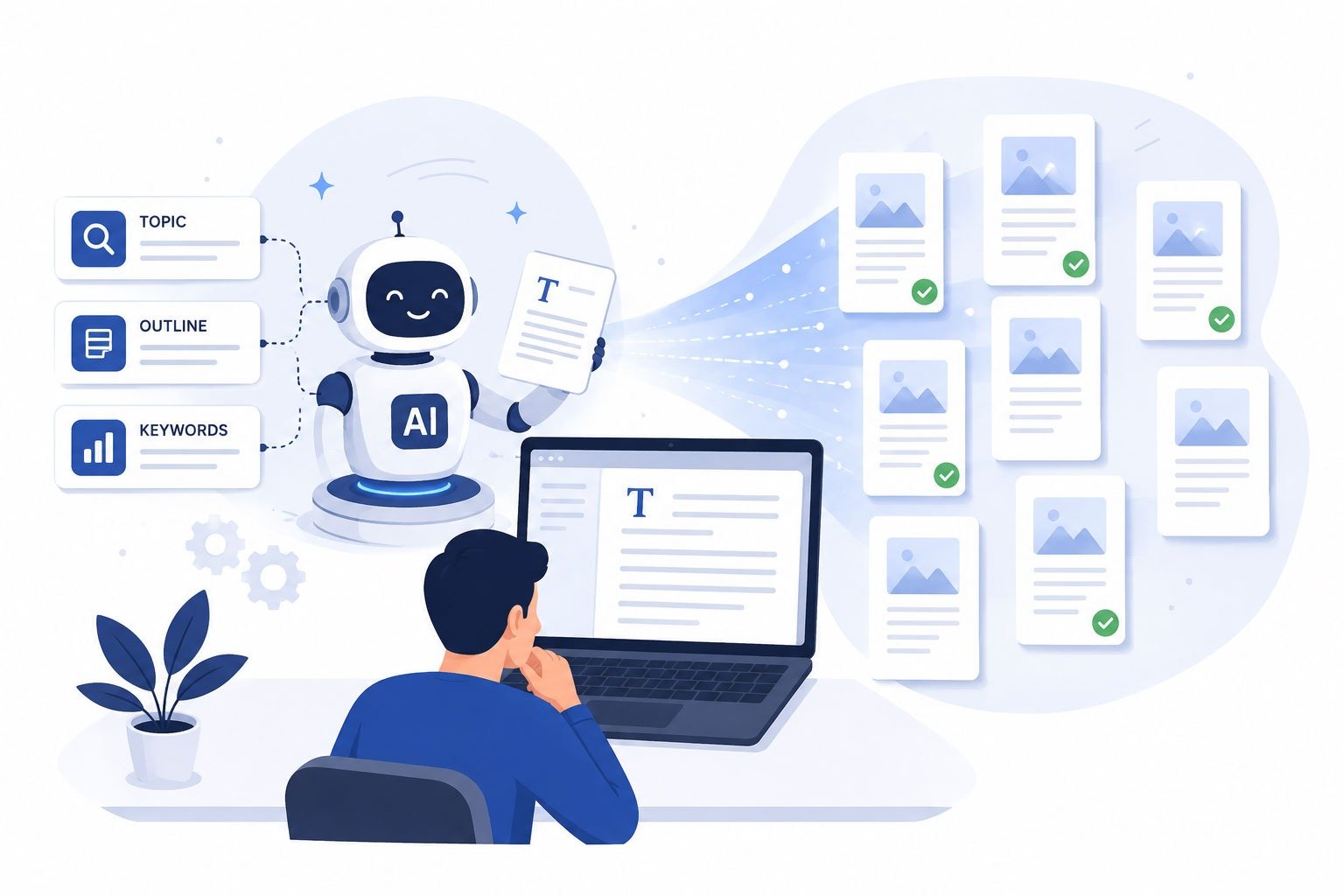
5- AI makes average content easier to produce
This might be the biggest change. Before AI, creating content at scale was difficult. Now almost everyone can do it. That means simply having more content isn’t much of a competitive advantage anymore.
If ten businesses use AI to write ten similar articles about the same topic, what makes one of them worth choosing? Maybe it’s:
- The original research.
- Actual customer experience.
- Useful example.
- A clearer explanation.
- Simply answers the question better.
When everyone can produce content, usefulness becomes more important than volume.
6- SEO doesn't move at the speed of AI
This is the part businesses sometimes find frustrating. AI can create an article in seconds. SEO results don’t work that way.
Search visibility can take time because you’re building something that needs to be discovered, evaluated, tested, improved, and trusted. Some pages perform quickly. Others take months. Some never perform at all.
That’s why SEO shouldn’t be treated like: “We published it, so where are the results?”
It’s closer to: “We published it. Now let’s see what the data tells us.”
Curious how AI can actually help your business grow? Exploring the right digital strategy can make all the difference.
So, should you use AI for SEO?
Absolutely. There is nothing wrong with using AI to make content creation faster. Use it for:
- Research assistance
- Content outlines
- Brainstorming
- First drafts
- Content refreshes
- Editing
- Summarizing information
- Finding gaps to explore
But don’t confuse faster content production with faster SEO. They’re not the same thing. AI can help you produce the words faster. It can’t replace the need to decide what deserves to be written, who it is for, why it matters, and what happens after it goes live.
Final Thoughts: The real advantage isn't using AI.
Everyone can use AI now. The advantage is knowing what to do with it. Because SEO was never just about writing blogs. And AI didn’t change that. It simply made one part of the process much faster.
The businesses that understand the difference will have a much better chance of turning that speed into something that actually matters: visibility, relevant traffic, and eventually, business.
About AVingenious
AVingenious is a software development company in Allahabad/Prayagraj helping startups grow through strategic web development, user-focused design, and performance-driven digital marketing. By combining strong digital experiences with smart growth strategies, we help businesses attract the right audience and turn more visitors into customers. Learn more about AVingenious and our services on our website.